Most Popular
 Get Up To 30% Off
3,527 Businesses Picked This Provider Today

Last updated:
Our hand-picked partners provide you with a range of Phone solutions to suit your needs. Compare our partners' options to find the optimum VoIP solution for you.

Award-winning VoIP provider
Visit Site
All-in-one business communications
Visit Site
Voice, video & text collab from anywhere
Visit SiteMost Popular3,527 Businesses Picked This Provider Today

3,527 Businesses Picked This Provider Today
 What is VoIP
Voice over Internet Protocol (VoIP) is a technology that allows you to make phone calls over the internet, bypassing traditional telephone lines. By converting your voice into digital packets and transmitting them over the internet, VoIP offers a cost-effective and efficient and efficient phone service solution.
Unlike conventional phone systems, VoIP does not require dedicated phone lines and works seamlessly in any location with an internet connection. In addition to affordability, it comes with a range of advanced features, including:
Moreover, VoIP systems deliver superior sound quality since the digital packets are less susceptible to interference compared to analog systems.
 Virtual Phone Key Features
When selecting a VoIP solution for your business, it's important to consider the features that best suit your needs. Here are some essential features to look for in a virtual phone service:
 Choose the Right VoIP Phone
Selecting the ideal VoIP phone service requires a careful evaluation of your business's unique needs. Here's a breakdown of what to consider based on the size of your business:
No matter your business size, reliable customer support and Service Level Agreements (SLAs) are crucial any phone service.
 Why VoIP is Good for Business
VoIP offers significant benefits, especially for small and medium-sized businesses (SMBs). Here's why it's a great choice of phone service:
VoIP phone service also allows businesses to scale their operations and improve customer service while reducing overhead costs.
 VoIP Phone vs Landline Phone
When comparing VoIP to traditional landline phone services, it's clear that VoIP offers many advantages:
| Feature | VoIP Phone | Landline Phone |
|---|---|---|
| Infrastructure | Internet-based, no physical wires | Relies on copper wiring |
| Cost | Lower, with low international rates | Higher, especially for long-distance |
| Flexibility | Highly flexible and mobile | Fixed to specific locations |
| Advanced Features | Call forwarding, voicemail-to-email | Limited to basic features |
| Integration | Easily integrates with digital tools | No integration with other systems |
VoIP delivers flexibility, lower costs, and advanced features that traditional phone services cannot match, making it the ideal solution for modern businesses.
 VoIP Use Cases
VoIP phone service has versatile applications across various industries. Some of the most impactful use cases include:
VoIP is also widely used in industries like finance, construction, nonprofits, and government, with its applications in phone service continuing to expand.

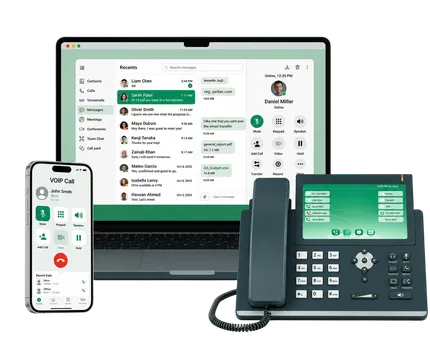
RingCentral is a leading unified communications and VoIP provider offering business phone, video meetings, team messaging, and contact center tools in one cloud platform. It's designed for companies that want scalable, feature-rich communications without managing on-premises hardware. Core features include unlimited calling in the U.S. and Canada, IVR/auto attendants, call queues, AI-powered call transcripts and summaries, and integrations with hundreds of business apps.
Pros:
Cons:
Best for: Businesses that prioritize reliability, collaboration, and advanced call handling, and are willing to pay a bit more for a full-featured, scalable platform.

Vonage is a long-standing VoIP and unified communications provider offering business phone, video meetings, messaging, and contact center solutions in the cloud. Its Vonage Business Communications (VBC) platform focuses on flexibility and customization, with 40+ voice and UC features, mobile and desktop apps, and strong integrations. It also offers communications APIs and a full contact center stack for companies that want to embed calling, SMS, and video into their own apps.
Pros:
Cons:
Best for: Small to mid-sized businesses and growing companies that want a customizable, API-friendly communications platform with room to expand into contact center and omnichannel experiences over time.

Ooma is a cloud-based VoIP and business phone provider built primarily for small and traditional brick-and-mortar businesses moving off landlines. Its Ooma Office platform focuses on simplicity and value: contract-free plans starting around $19.95 per user per month, 100+ built-in features, and plug-and-play hardware plus mobile and desktop apps. Core tools include a virtual receptionist, ring groups, digital/analog fax, music on hold, and unlimited calling in the U.S. and Canada (and often Mexico/Puerto Rico, depending on plan).
Pros:
Cons:
Best for: Cost-conscious small and midsize businesses, or traditional offices transitioning from landlines to VoIP, that want an easy, reliable system with strong core calling features rather than deep integrations or enterprise-grade analytics.
Business VoIP (Voice over Internet Protocol) is a phone service that uses your internet connection instead of traditional phone lines. It lets you make and receive calls, often with advanced features like call routing, voicemail-to-email, and more.
VoIP converts your voice into digital data and sends it over the internet to the other party, then converts it back to audio. All you need is a stable internet connection and compatible devices (IP phones, softphones, or mobile apps).
Yes - when paired with a strong internet connection and quality provider. Many business VoIP services offer uptime guarantees, call redundancy, and automatic failover to keep you reachable.
With enough bandwidth and a good network, VoIP call quality is equal to or better than landlines, often supporting HD voice for clearer conversations.
In most cases, yes. This process is called number porting, and your provider will help transfer your existing numbers to the VoIP service.
Typically, yes. VoIP reduces line rental costs, long-distance charges, and on-site hardware needs. Most providers offer flat-rate plans and bundled features.
Absolutely. VoIP is ideal for remote and hybrid teams. Staff can make and receive business calls from anywhere using softphones or mobile apps, while still showing your business caller ID.
Yes, when your provider uses encryption, secure data centers, and strong authentication. You should also secure your own network with firewalls and strong passwords.
As a general rule, plan for about 100 Kbps (0.1 Mbps) of upload and download per simultaneous call, plus extra for other internet use.
Most modern VoIP systems integrate with popular CRMs and business apps, enabling click-to-call, call pop-ups, and automatic logging of call activity.
VoIP with voice, video & text from $13.99/line/mo